

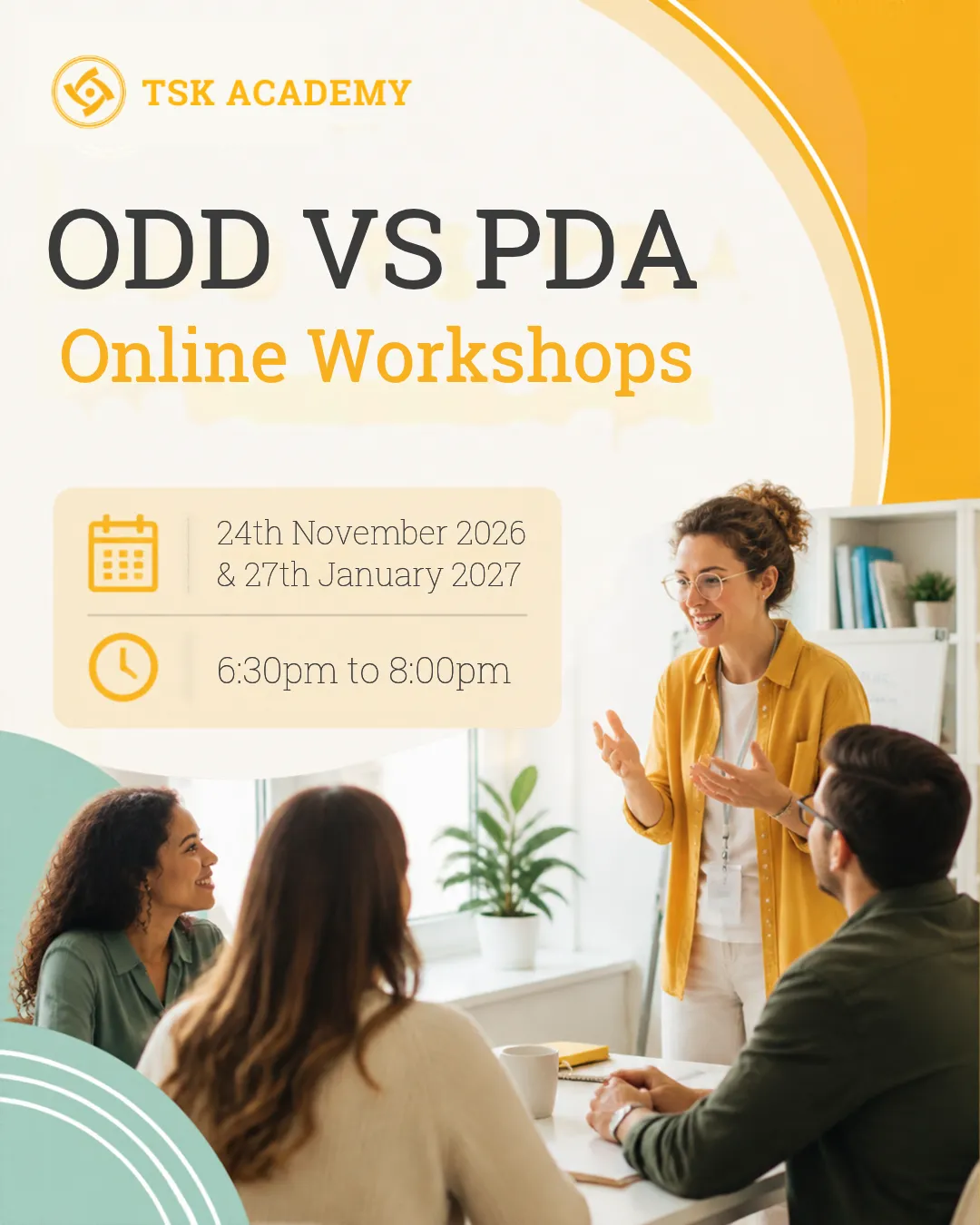
ODD vs PDA: Understanding the Differences and Supporting Regulation
When a child says “NO,” what are they really communicating?
Is it defiance, anxiety, overwhelm, a need for autonomy, or something else entirely?
At TSK Academy, we believe that understanding what lies beneath behaviour is essential to creating environments where children and young people feel safe, supported, and understood.
Following the interest in our previous PDA workshops, we are delighted to introduce our new ODD vs PDA: Understanding the Differences and Supporting Regulation workshop, taking place online on two upcoming dates.
Upcoming Workshop Dates
Tuesday, 24th November 2026
6:30pm – 8:00pm
Wednesday, 27th January 2027
6:30pm – 8:00pm
Cost: €35 per person
Duration: 90 minutes | Live Online Workshop
Looking Beyond the Behaviour
When children and young people refuse, argue, withdraw, or become distressed, it can be tempting to focus on the behaviour we see.
But what if we are missing what is happening underneath?
Oppositional Defiant Disorder (ODD) and Pathological Demand Avoidance (PDA) can present in similar ways, yet the experiences, needs and factors influencing these behaviours may be vastly different.
A response that supports one child may unintentionally increase anxiety or distress for another.
Understanding these differences matters.
This practical, interactive workshop moves beyond compliance-based approaches to explore how we can respond with curiosity, compassion, and confidence, while maintaining appropriate boundaries and supporting regulation.
What Will We Explore?
During this 90-minute session, we will explore:
- ODD and PDA: Understanding their key characteristics, similarities, and differences, including the different ways they are understood.
- Looking Beneath Behaviour: Recognising the potential roles of anxiety, overwhelm, frustration, autonomy, and perceived demands.
- Understanding Escalation: Exploring how our language, expectations and responses can influence a young person's ability to regulate.
- Practical Support Strategies: Using communication, flexibility, predictability, and collaborative approaches to reduce distress.
- Inclusive Behaviour Support: Applying TSK Academy's Inclusive Behaviour Support Framework to strengthen relationships, protect dignity and support regulation.
Bringing Learning into Practice
This is not simply a workshop about definitions or diagnostic labels.
Participants will work through three realistic school-based case studies, exploring what behaviour might be communicating, how different responses can influence outcomes and what practical adjustments could make a difference.
We will also introduce our Pause–Protect–Partner Model, encouraging adults to pause and regulate their own responses, protect the young person's dignity and sense of safety, and partner with them to find a way forward.
Our focus is on practical approaches that participants can begin applying immediately.
Who Should Attend?
This workshop is suitable for teachers, Special Needs Assistants (SNAs), Early Learning and Care (ELC) and School-Age Childcare (SAC) educators, social care professionals, family support workers, parents and anyone supporting children and young people.
No previous knowledge of ODD or PDA is required.
What Will You Take Away?
Participants will leave with a clearer understanding of the differences between ODD and PDA, practical strategies for reducing escalation, examples of supportive language and reflective tools to help inform their responses.
Most importantly, participants will be encouraged to shift the question from **“How do I stop this behaviour?” to “What might this young person be communicating, and how can I support them?”
Book Your Place
Choose the date that suits you:
Tuesday, 24th November 2026 | 6:30pm–8:00pm
Wednesday, 27th January 2027 | 6:30pm–8:00pm
€35 per person | Live Online
Join TSK Academy for 90 minutes of practical learning, reflection and strategies designed to make a meaningful difference in how we understand and respond to behaviour.
Because supporting regulation is not about gaining control over behaviour. It is about understanding what a young person needs to feel safe, supported and understood.
TSK Academy – Moving Beyond Awareness to Inclusive Practice.